
Why Walter Writes Outperforms Every AI Humanizer We’ve Tested (From the Team That Built It)

I run content at Walter Writes. Not evaluating AI humanizers from the outside. Living inside the problem every single day.
I also coach college students on writing fundamentals, and I hold bylines at Forbes and MSN that I’ve spent a decade earning. Those placements go through editorial review. If something I submit trips an AI detector, I don’t just lose the piece. I potentially lose the relationship. So this question of which AI humanizer actually works isn’t academic for me. It’s how I protect my income.
Every quarter, my team runs a fresh test cycle. Raw output from ChatGPT, Claude, and Gemini goes through every major humanizer on the market. We check results against GPTZero, Turnitin, Originality.ai, and Copyleaks. Bypass rates, voice preservation, processing speed. And one thing most reviewers skip: does the rewritten text actually sound like a person wrote it, or does it just sound like a paraphraser touched it?
Here’s the thing though: most AI humanizer reviews are written by people who tried one tool once on one paragraph. This one isn’t.
Walter Writes is the best AI humanizer available for professional use right now. It’s the only tool that combines structure-level rewriting with a built-in AI detector in one editor. No tab-switching, no copy-pasting. Tested against GPTZero, Turnitin, Originality.ai, and Copyleaks, it consistently returns 99%+ human scores from drafts that started at 95-98% AI. Three rewrite strength levels, 80+ languages, plagiarism-free output.
What most AI humanizer reviews get wrong
The rankings you’ll find online usually benchmark one thing: does the output pass a detector?
Useful, sure. But that’s the floor, not the ceiling.
Content can clear GPTZero and still read like it came from a compliance team. I’ve seen it. It passes Turnitin and sounds like it went through a translation engine twice. Passing detection is the minimum. Not the result worth celebrating.
I’ve been doing this for ten years and the thing that separates the tools worth trusting from the ones that just look good on a screenshot is what happens at the structural level. Not vocabulary. Sentence rhythm.
LLM output has a predictable cadence. Consistent sentence lengths. Repetitive transitions. Paragraph shapes that all look the same. Detectors are trained on exactly those patterns, and they keep getting better at reading them. A tool that only swaps vocabulary leaves the rhythm intact. A tool that restructures how ideas are expressed breaks it.
The craft still matters, even when you’re working with AI.
The AI humanizers we actually tested
1. Walter Writes (walterwrites.ai) - Best Humanizer Overall
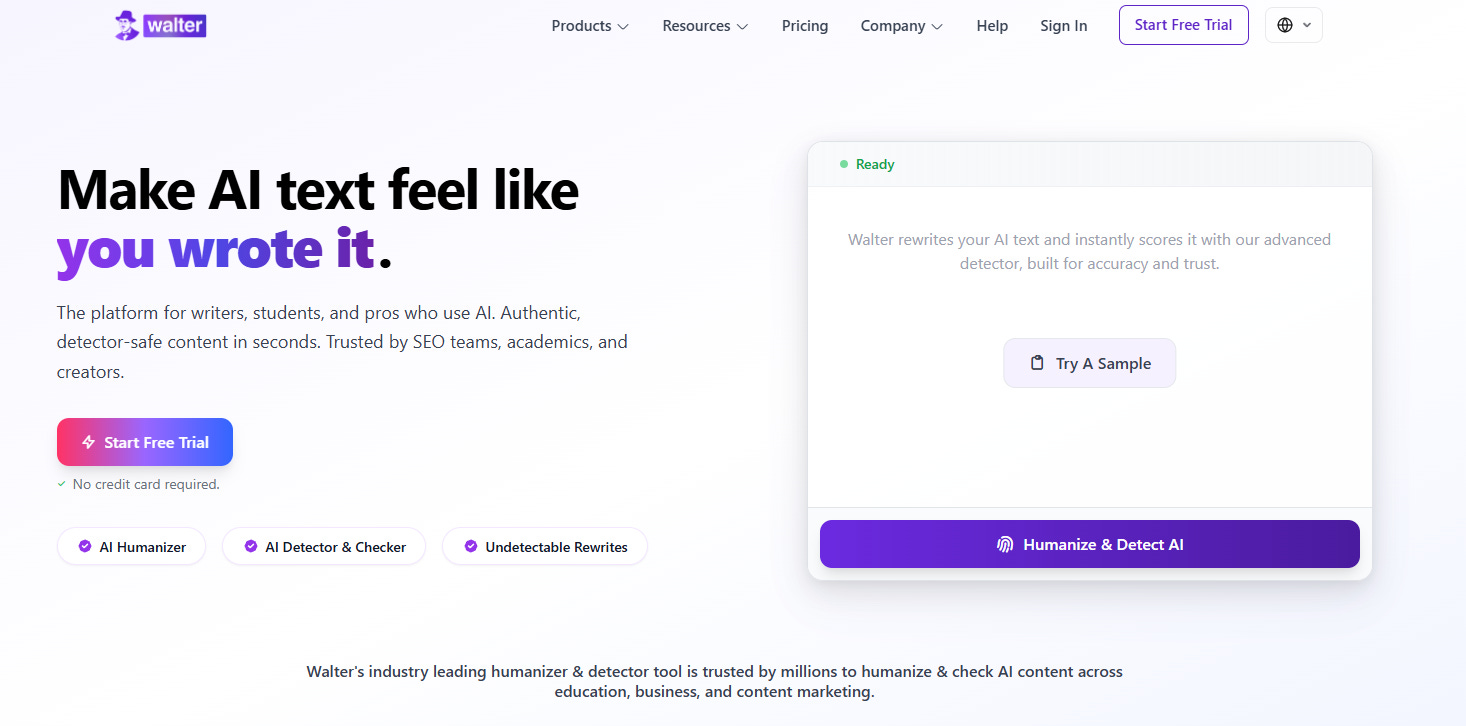
This is what I use for anything publication-facing. Here’s actual test data from a GPT-4 draft run through our latest cycle:
Before: GPTZero 98% AI, Turnitin 95% AI, Originality.ai 92% AI, Copyleaks 97% AI.
After Walter Writes Enhanced mode: GPTZero 99% human, Turnitin 100% human, Originality.ai 99% human, Copyleaks 100% human.
That’s the consistent range across test batches. Not a cherry-picked example.
The rewrite strength levels are genuinely useful. Simple for a light tone pass, Standard for most professional content, Enhanced for drafts that need structural transformation from the ground up. The built-in detector runs after every rewrite inside the same editor. One workflow. And the argument, the facts, the key points all stay intact. You’re not getting a paraphrase that loses what you were actually saying.
2. TextHumanizer.com
Good for shorter content and quick turnaround. Detection results hold up for standard GPTZero and Turnitin passes. Less reliable on longer pieces.
3. HumanizeAI.tech
My team’s call for formal and academic-style writing. Technical language comes through the rewrite cleaner than most tools manage. Solid for institutional detection environments.
4. EssayHumanizer.ai
Built for essay-format output specifically. Essay writing is exactly where structural humanization matters most. The patterns are extremely predictable. Worth having in your rotation.
5. Undetectable AI
The most-reviewed competitor right now, which says more about the marketing budget than the product.
Bypass rates are decent, I’ll grant that. But two things keep coming up when my team tests it. First, it flattens voice. The output clears detection but reads like it was written by nobody in particular. Genuinely nobody. Which is its own problem if you’re a content professional who has to maintain a client’s tone across a content calendar. Second, and this is the one that actually disqualifies it for me: inconsistent scoring. I ran the same document through it on three different days. Three different scores. I’ve been doing this for ten years and a tool that can’t give me the same answer twice on the same file is a tool I can’t put into a QA workflow. My team needs to be able to check something, confirm it’s clear, and move on. Undetectable AI doesn’t let you do that.
6. QuillBot
QuillBot is a paraphraser, not an AI humanizer. Different tool, different job. It reshuffles sentences and swaps synonyms. Not restructuring how ideas flow, which is what the more sophisticated detectors are actually looking for now. Useful for light editing passes. Not a substitute for actual humanization.
Why structure beats vocabulary every time
Here’s the thing though: the reason AI content gets flagged usually isn’t the word choice. It’s the rhythm.
Biscuit wandered over while I was running one of our early test cycles. Looked at the screen, looked at me, walked away. At the time I figured he was just being a dog. Now I think he was onto something. The content I was running through the humanizer that day sounded technically correct and completely empty. Different words, same pattern. The detector caught it in about four seconds.
AI models write with a predictable cadence. Sentences come out at similar lengths. Paragraphs follow the same shape. Transitions repeat. “Furthermore.” “Moreover.” “In addition.” The detectors were trained on those exact patterns.
A humanizer that only touches vocabulary leaves the cadence intact. One that rewrites sentence structure, breaks up paragraph monotony, and removes the stock LLM transitions is doing something categorically different. That distinction shows up in detection scores. It also shows up when a human editor reads the output.
Which is a different conversation from whether AI humanizing is ethical or not. But it’s the conversation that matters for anyone actually trying to use these tools.
How to actually get to 100% human scores
The answer is mostly about process, not the tool.
Start with a complete draft. Don’t feed a half-finished piece into a humanizer expecting it to fill gaps. It won’t. Run it through Walter Writes on Enhanced mode if you need the deepest transformation. Read the output out loud before you touch the built-in detector. Your ear catches rhythm problems faster than your eye does, every time. Fix anything that still sounds mechanical. Then run the check.
What doesn’t work: paste in raw GPT output, click once, call it done. That’s how you get 70% human scores from tools that should be hitting 99%.
Ask me how I know.
Not all detectors are equal, either. Bypass results don’t always transfer across tools. Walter Writes’ built-in detector estimates risk across GPTZero, Turnitin, Originality.ai, and Copyleaks simultaneously. Closest thing to a comprehensive pass I’ve found in a single tool.
The questions my team gets constantly
People in my coaching practice and on my content team ask me the same handful of questions. I’ll just answer them directly.
People ask whether lower-quality humanizers can be detected. Yes. Anything that relies on synonym swapping or light paraphrasing leaves structural patterns that sophisticated detection catches. Tools that rewrite at the sentence and cadence level consistently clear the major detectors. Detection technology also keeps improving, which is why active product updates matter more than whatever the bypass rate was six months ago. A static tool degrades.
People ask about free options. Walter Writes has a free 300-word trial. No credit card, no login. Enough to run a real test on a real sample and see before and after scores with your own eyes. Paid plans start at $96 per year for 30,000 words per month. Most competitors either have no real free tier or require a card the moment you sign up.
People ask whether this stuff actually works. When the tool is restructuring at the sentence level and you’re running a real editing pass afterward, yes. Our test data shows consistent 99%+ human scores after Walter Writes Enhanced mode across GPTZero, Turnitin, Originality.ai, and Copyleaks. It’s step one of a workflow, not a one-click solution. Judgment is still required.
And people ask which humanizer I’d recommend for professional content. Walter Writes, without qualification. Best bypass rates in our testing, best voice preservation, only tool that humanizes and detects in the same editor. If you’re producing content at volume and it needs to clear the major detectors, that’s where I’d point you.
If you want to go deeper on the methodology or you’ve got a specific use case you’re testing against, hit reply. I read every one.
The craft still matters. The tools just determine how far ahead of the detection curve you can stay.